
A plunge pool is a small pool with a clear purpose. It’s made for quick cool-downs, relaxed dips, and everyday use without eating up your whole backyard. If a full-size pool feels like too much space, too much cost, or too much upkeep, a plunge pool is often the practical middle ground.
In this guide, you’ll learn what a plunge pool is, how people actually use it, the typical size and depth ranges, how it compares to a standard pool, and what usually drives the final price.
What’s a Plunge Pool?
A plunge pool is a compact pool designed for dipping, cooling off, and lounging rather than lap swimming. You’ll also see terms like cocktail pool, dipping pool, or cold plunge pool. In most cases, they’re describing the same idea: a pool that fits tighter spaces, still feels like “real water,” and is simple enough that you’ll use it more often.
What does a plunge pool look like?
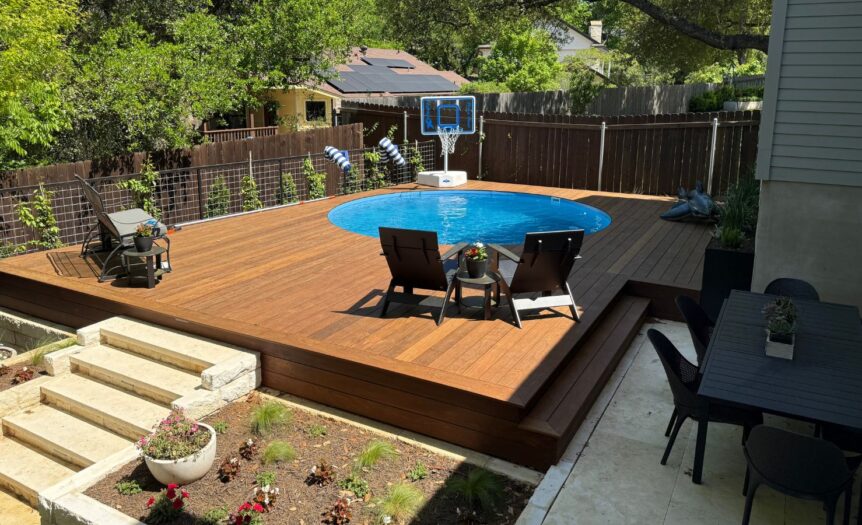
Most plunge pools keep the design clean: rectangular or round, with steps or a built-in bench so you can sit comfortably. Rectangular shapes tend to feel longer for their footprint, while round shapes often feel more social because people naturally face toward the center.
Above Ground Plunge Pool also lands in a useful middle zone. It’s more “pool” than a hot tub because you can fully submerge and keep the water crisp, but it stays more space-friendly than a traditional backyard build.
What Is a Plunge Pool Used For, and How Do You Use It?
Plunge pools work best when they’re easy to use on ordinary days. Most owners treat them like a reset: step in for 10 to 15 minutes after work, after a workout, or after yard time. Because the pool is quick to get into and easier to maintain than a larger build, it’s common for people to use it more consistently.
In real life, usage usually falls into a few simple patterns: a fast cool-down in hot weather, a quiet sit on the bench in the evening, or light movement in the water when you want something low impact. It’s not meant for lap swimming or big in-water parties, but it covers what many people actually do with a pool week to week.
Plunge Pool Sizes and Dimensions
When people search plunge pool dimensions, they’re usually trying to answer two things: will it fit, and will it feel satisfying once it’s in the yard.
A common size range is roughly 6 to 12 feet wide and 10 to 20 feet long, depending on the layout and how much seating is built in. That’s noticeably smaller than many residential pools, which often land closer to 10 to 20 feet wide and 20 to 40 feet long. The size difference is the point: you get the sensation of being in a pool without turning the entire backyard into a pool project.
Typical plunge pool dimensions
Most plunge pools are designed around a comfortable seating zone plus enough open water to move around. Rectangles often feel roomier if you like stretching out, while round pools can feel more conversational.
One detail that gets overlooked: plan for the space around the pool, not just the shell. Even a small pool can feel tight if there’s no room for entry steps, a walking path, or a small deck or patio area where you’ll actually sit, dry off, and hang out. If you want inspiration for layouts that feel finished and functional, see pools with decks or cocktail plunge pools by StainlessSwim – the company has the best selection of affordable plunge pools.
Largest Plunge Pool: How Big Can a Plunge Pool Be?
At the upper end, plunge pools start to feel like small swimming pools. You’re still in “compact compared to a full-size build” territory, but you gain breathing room: more float space, less turning, and a more comfortable feel with a few people in the water.
This is where the decision becomes more about how you’ll live with it. If you want quick dips and minimal footprint, stay closer to the classic plunge range. If you want something that can double as a mini pool for lounging and hosting, going larger can make sense, especially if you’ll also build out deck space.
Plunge Pool vs Regular Pool vs Swimming Pool
A plunge pool is built around quick entry and quick comfort: cool down, sit, reset. A regular backyard pool is usually meant to handle more variety such as games, floating, and casual swimming. A lap-focused swimming pool is primarily about length and swim space.
| Feature | Plunge Pool | Regular Pool | Swimming Pool (lap-focused) |
| Main purpose | Cool down, relax, quick dips | All-around backyard fun | Swimming/laps, fitness |
| Yard space needed | Minimal | Medium to large | Large (length matters) |
| Best for small yards | Yes | Sometimes | Rarely |
| “Swim space” | Limited | Moderate | High |
| Hangout / lounge feel | High | High | Medium |
| Build complexity | Often lower | Medium | Higher |
| Typical upkeep | Lower/easier | Medium | Medium to higher |
| Why people choose it | Fits tight spaces, simple ownership | Balanced “do it all” | Fitness-first, real swim room |
A straightforward way to think about it: plunge pools are designed for getting in often, regular pools are designed for spending long stretches in the water.
Plunge Pool Depth and Temperature Options
Depth is what gives a plunge pool that immersive feel. Many plunge pools fall within about 4 to 8 feet, and it’s common to see builds around 5.5 to 7 feet deep when the goal is full submersion rather than a shallow sit-in experience. Shallower “cocktail-style” builds can land closer to 3 to 4 feet, especially when seating and lounging are the priority.
Temperature is the bigger lifestyle choice. Kept cool, a plunge pool is a fast way to drop your body temperature in hot weather. Heated, it becomes a soak-friendly pool for evenings and shoulder seasons. For homeowners who want to heat their plunge pool sustainably, working with a solar pool heating company like Suntrek Solar provides a reliable, energy-efficient way to maintain comfortable water temperatures year-round without relying on gas or electric heaters. Some owners keep it cool in summer and warm it in winter, depending on equipment and energy costs.
As a planning range, heater purchase and installation are often around $1,800 to $4,200, and monthly operating cost can swing widely based on climate, insulation, the temperature you maintain, and the heating method.
Plunge Pool Cost and Installation Cost
Plunge pool pricing depends less on a single “standard number” and more on what you’re building and what your yard requires.
Common cost drivers include size and depth, material and finish, and the equipment package, especially heating and filtration. Installation can move the budget the most because every property is different: access to the yard, ground prep, leveling, drainage, plumbing runs, and electrical work all add up.
A realistic planning range many homeowners see is about $10,000 to $40,000, with an average project often cited around $28,000. In broader ranges, you’ll also see examples as low as $3,000 and as high as $75,000 depending on scope and site conditions. For size-based expectations, small simple builds are often described in the $10,000 to $15,000 range, while larger or more upgraded options commonly land around $20,000 to $30,000+.
Permits and safety requirements can also matter. In many areas, permits can run roughly $550 to $3,100, and a required safety fence may add $1,500 to $10,000 depending on style and layout.
If you want predictability, it helps to lock in three decisions early: the size, the placement (above ground vs in-ground), and the must-have features. Everything else becomes easier to price once those are set.
Above Ground Plunge Pool Ideas
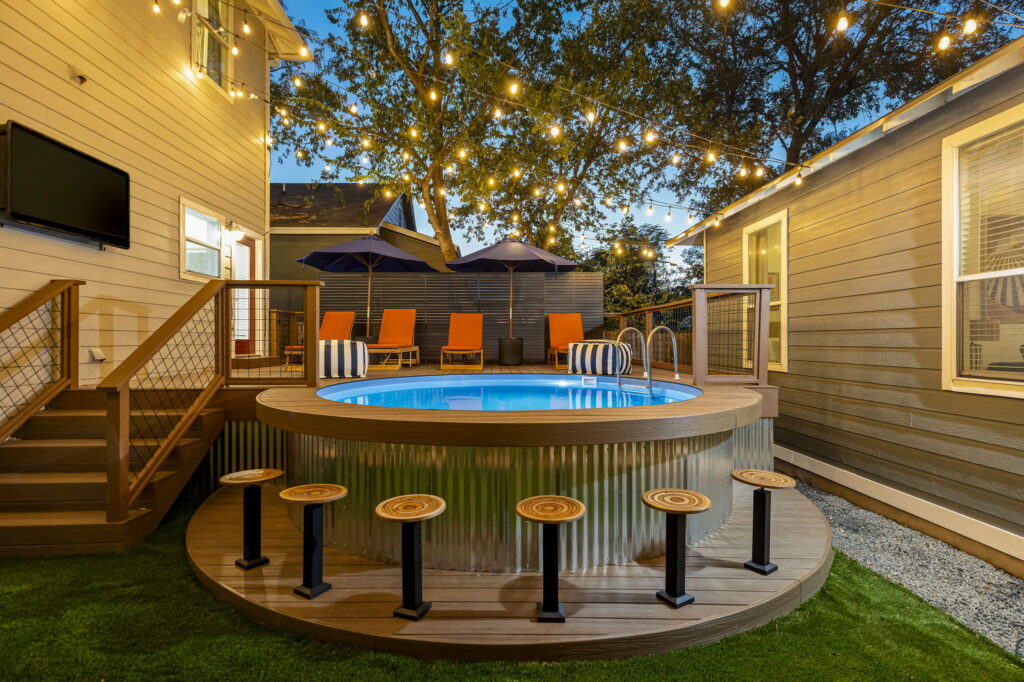
Above-ground plunge pools are a strong option if you want the plunge experience with less disruption and often lower site work than an in-ground project. Cost ranges vary widely, but many people consider above-ground because it can reduce excavation and shorten timelines. You’ll see budget discussions that start around $3,000 for basic options and stretch up to $30,000 for more custom, finished setups.
The difference between “temporary-looking” and “designed-on-purpose” usually comes down to what you build around it. A partial wrap deck or platform instantly creates a usable zone for steps, towels, and seating. Semi-recessed styling can look especially clean: the pool sits partially above grade while the surrounding area is built up with decking, planters, or privacy screening so it reads like a permanent backyard feature. Soft lighting and a comfortable entry setup can do a lot, too.
Done well, an above-ground plunge pool can look as polished as an in-ground build, while staying simpler to install and easier to fit into different yard layouts.
Conclusion
A plunge pool is a smart way to get the real “pool” feeling without turning your whole yard into a construction project. If your goal is to cool off fast, relax more often, and keep ownership simple, the plunge format checks the boxes. The right size and depth come down to how you will use it day to day, while the final cost is usually driven by placement, site prep, and equipment choices like heating and filtration.
If you want an above ground plunge pool that looks intentional, lasts, and fits cleanly into a modern backyard setup, start by picking your footprint and the kind of hangout space you want around it. Then you can build the project around those decisions with fewer surprises.