


The backyard has quietly become the most power-hungry part of many homes. A hot tub alone can add 3-6 kWh to your daily consumption, an outdoor kitchen brings a fridge and lighting, the workshop in the garage runs saws and compressors, and more of us are now plugging an EV into the same panel. If your electric bill has crept past the point where a mid-size solar array would cover it, you have probably started seeing one number come up again and again in your research: 15 kilowatts.
Here is a practical look at what a 15kW solar system actually delivers, how much space it needs, and how to decide whether it is the right size for your property.
What a 15kW System Really Produces
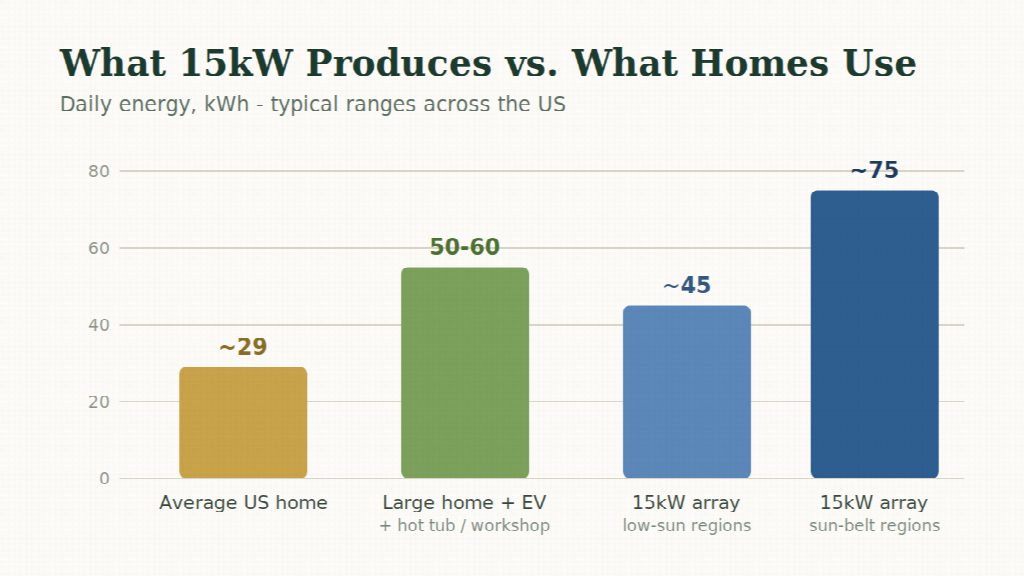
The 15kW figure describes the peak output of the solar array – the combined rating of all the panels under ideal sun. What matters for your household is daily energy production, and that depends on where you live. As a rule of thumb, a well-placed 15kW array generates roughly 45-75 kWh per day: closer to the low end in the cloudy Northeast or Pacific Northwest, closer to the high end in the Southwest sun belt.
For context, the average American home uses about 29-30 kWh per day. In other words, a 15kW system is not an average-home system – it is sized for properties that consume two to three times the norm. That typically means one of the following:
- A larger home (2,500-4,000+ sq ft) with central air conditioning
- A household charging one or two electric vehicles
- A property with serious outdoor loads – a hot tub or pool pump, a heated greenhouse, a workshop, landscape lighting, a well pump
- A rural or off-grid property where the system must cover everything, including heating with a heat pump
If two or more of those describe your situation, 15kW is a realistic target rather than overkill.
How Much Space It Takes – Roof or Yard
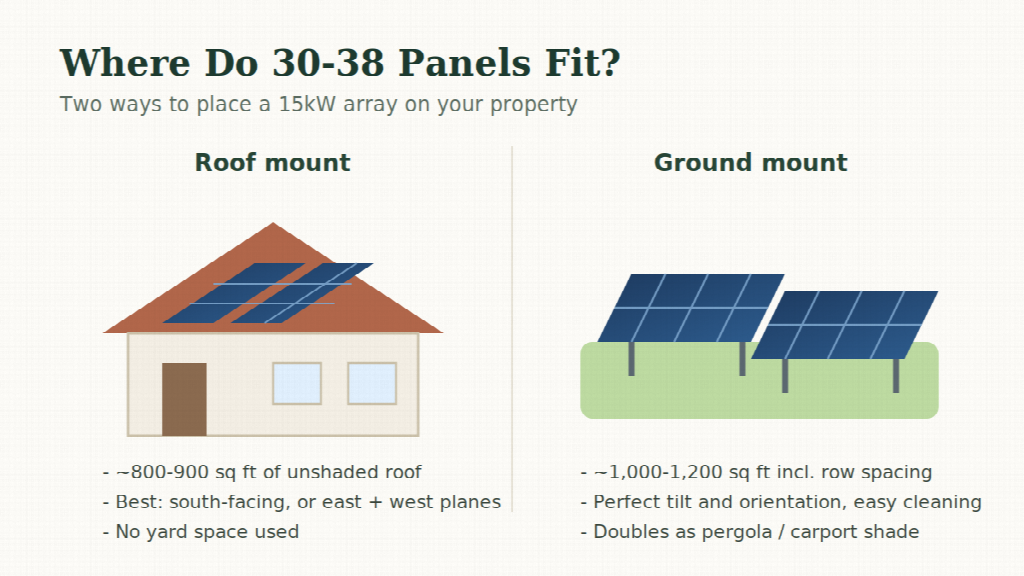
A 15kW array is usually built from 30-38 panels in the 400-500 watt class. On a roof, that translates to roughly 800-900 square feet of unshaded, well-oriented surface – a large south-facing roof plane, or two planes facing east and west.
If your roof is complicated, shaded, or simply full, the garden itself is often the better location. Ground-mount racking lets you set the perfect tilt and orientation, keeps panels accessible for cleaning, and avoids roof penetrations entirely. Plan on a clear area of about 1,000-1,200 square feet once you account for row spacing – comparable to the footprint of a large vegetable garden. Many homeowners pair a ground-mount array with practical landscaping: pollinator-friendly ground cover underneath, or panels doubling as a shade canopy over a pergola, carport, or chicken run.
Grid-Tied, Hybrid, or Off-Grid?
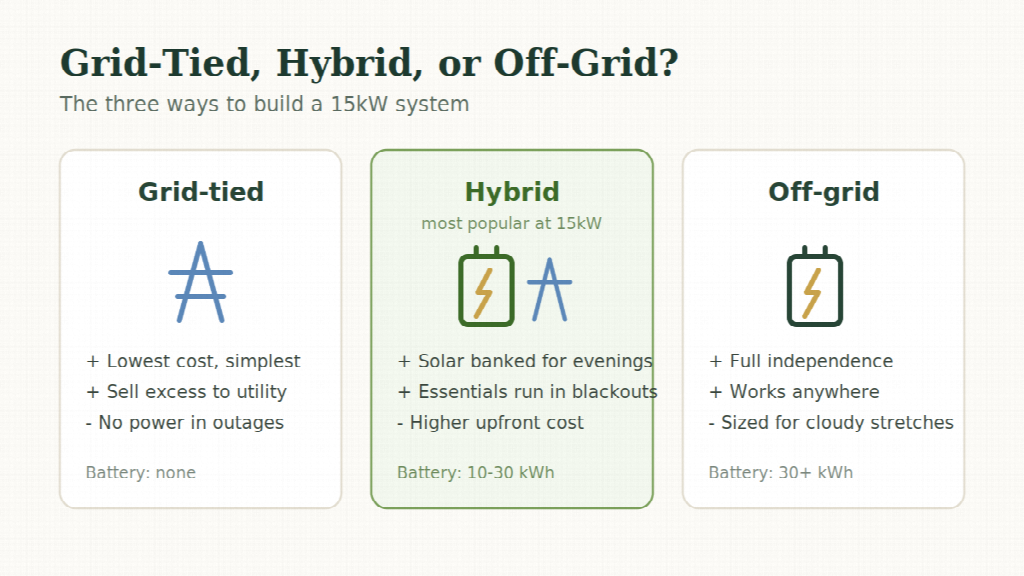
At this size, the more important decision is not the panels but the architecture of the system:
- Grid-tied: the simplest and cheapest option. Excess daytime power is exported to the utility. The catch – no backup when the grid goes down.
- Hybrid (grid-tied with battery): a hybrid inverter plus a battery bank, typically 10-30 kWh at this system size. You bank your solar for the evening and keep essential circuits – fridge, freezer, well pump, internet – running through outages.
- Off-grid: full independence, sized so the array and battery carry the home through cloudy stretches. A 15kW array with 30+ kWh of lithium storage is a common configuration for full-time off-grid homes and homesteads.
If you live where storms or wildfire shutoffs make outages a yearly event, the hybrid route usually earns its extra cost the first time your freezer full of garden produce survives a two-day blackout.
What It Costs and Where the Money Goes
Pricing varies widely depending on how much of the work you take on. A professionally installed 15kW system commonly lands in the $30,000-45,000 range before incentives. Complete equipment packages – panels, hybrid inverter, racking, and battery storage bundled and pre-matched – run considerably less, which is why DIY-capable homeowners and owner-builders gravitate to them. Retailers that specialize in packaged systems, such as this collection of
15kW solar power system kits at Eco Solar Kits, list complete off-grid and hybrid bundles with lithium batteries included, so you can compare real equipment costs before talking to an installer.
Two budgeting notes worth flagging. First, incentives change: federal and state programs have shifted several times in recent years, so verify what currently applies to your project and property type before you count on a credit. Second, at 15kW you may cross utility thresholds for interconnection review, and some jurisdictions require an engineering stamp for ground-mount structures – budget a little time for paperwork, not just panels.
Quick Sizing Checklist
Before committing to 15kW, spend ten minutes with your last twelve utility bills:
- Add up a full year of kWh and divide by 365 for your true daily average – summer-only math oversizes the system.
- Add planned loads: an EV adds roughly 8-12 kWh per day of commuting, a hot tub 3-6 kWh, a heat pump considerably more in winter.
- Multiply your daily target by 1.2-1.3 to cover system losses and battery round-trip inefficiency if you are adding storage.
- Divide by your local peak sun hours (3.5-5.5 for most of the US) to get the array size in kW.
If that math lands you anywhere between 12 and 17 kW, a 15kW package is the sweet spot – big enough to absorb an EV or a new hot tub later, without paying for capacity you will never use.
The Bottom Line
A 15kW solar system is the point where solar stops being a supplement and starts being a genuine home power plant – one that can run the house, the garden, the workshop, and the car. Get the sizing math right, decide early whether you want battery backup, and choose between roof and ground mount based on which gives you better sun. Do those three things, and the rest of the project is mostly assembly.

