
A search for a luxury home in Bangkok tends to imply a single market. The reality on the ground is closer to several distinct micro-markets, each shaped by a different era of the city’s development, a different kind of buyer, and a different relationship to land. Understanding that geography matters as much as understanding price per square metre, since where a home sits in Bangkok says a great deal about what kind of life it was built to support. The sections below walk through four of the city’s defining luxury residential geographies, from the diplomatic core to the newest frontier north of the city.
Sathorn: Bangkok’s Original Address of Power
Long before Sukhumvit became synonymous with prestige, Sathorn held that position. The district takes its name from the canal built in the late 1880s by Luang Sathorn Rajayutka, a Chinese-Thai businessman honoured by King Chulalongkorn for the project, and the road that followed it quickly became the address of choice for Bangkok’s elite and, in time, for foreign missions. Sathorn Road today still hosts embassies including Austria, Australia, Belgium, Canada, Germany, Singapore, and the United Kingdom, a diplomatic concentration that has defined the neighbourhood’s character for the better part of a century.
Little of the original residential fabric survives intact. A handful of colonial-era mansions from that period still stand, several preserved through adaptive reuse rather than demolished for redevelopment, offering a rare glimpse of the district’s residential origins before its transformation into Bangkok’s financial core. In their place, Sathorn has become one of Bangkok’s most expensive vertical addresses, with new luxury condominium launches commonly priced between 200,000 and 300,000 THB per square metre. For buyers specifically seeking a landed luxury house, Sathorn’s land economics have made that increasingly difficult to find within the district itself.
Sukhumvit’s Inner Sois: New Money Behind Old Trees
Where Sathorn represents old diplomatic Bangkok, the inner sois off Sukhumvit around Thonglor, Ekkamai, and Phrom Phong represent the city’s contemporary luxury culture. The main roads are dense with restaurants, boutique retail, and some of Bangkok’s most recognised ultra-luxury condominium towers, several clustered around Sukhumvit Soi 39 in particular. Step off the main frontage into the quieter side sois, however, and a different pattern emerges: pockets of landed houses on modest but valuable plots, increasingly rare and correspondingly expensive precisely because so little land remains undeveloped in this part of the city.
Buyers drawn to this geography tend to prioritise lifestyle access above all else, walkable dining and nightlife, proximity to international offices, and the social cachet of a Thonglor or Phrom Phong address. What this geography does not offer in meaningful supply is scale: the large plots, private gardens, and low-density streets that define a true luxury estate elsewhere in the city.
Nonthaburi: Bangkok’s Original Alternative to the Inner City
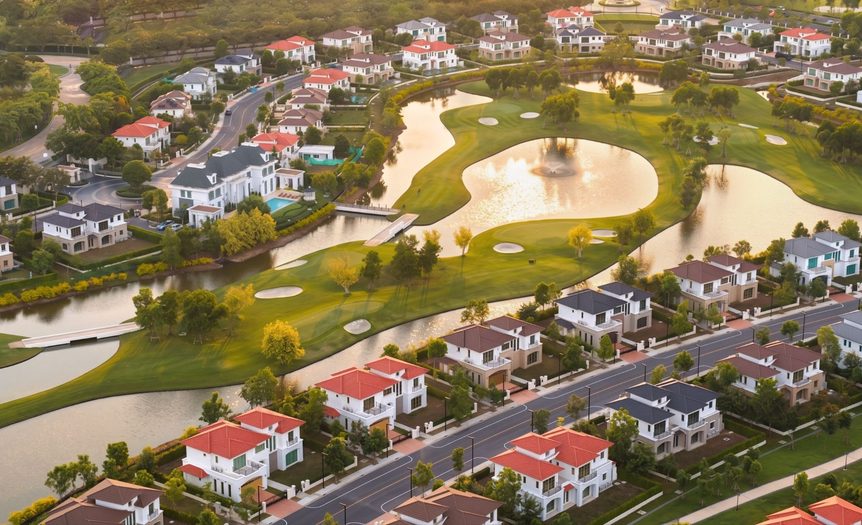
North of the city in Nonthaburi, a different residential model took shape in the late 1980s: large, gated, internationally oriented communities organised around a shared lake or green centrepiece, with schools, retail, and recreational facilities built inside the perimeter rather than commuted to from outside. It amounted to less a single address than a self-contained small town, offering considerably more space and quieter streets than anything available in the inner sois.
That model’s enduring appeal illustrates a pattern that has since been repeated elsewhere in Greater Bangkok. Families relocating to Thailand, particularly those with children, have long been willing to trade proximity to the city centre for space, security, and a school-anchored community. That same trade-off is the one the newest generation of developments north of Bangkok has since scaled up considerably further.
Pathum Thani: Where Land Still Allows Scale
The common thread running through Sathorn and inner Sukhumvit is land scarcity. Both districts reached the limits of their developable land decades ago, which is precisely why Bangkok’s newest luxury landed-home developments have moved north, into Nonthaburi and, increasingly, Pathum Thani. Continued rail expansion has extended practical commuting range considerably further from the centre than was feasible a decade ago, turning what were once considered peripheral districts into locations serious buyers now actively evaluate.
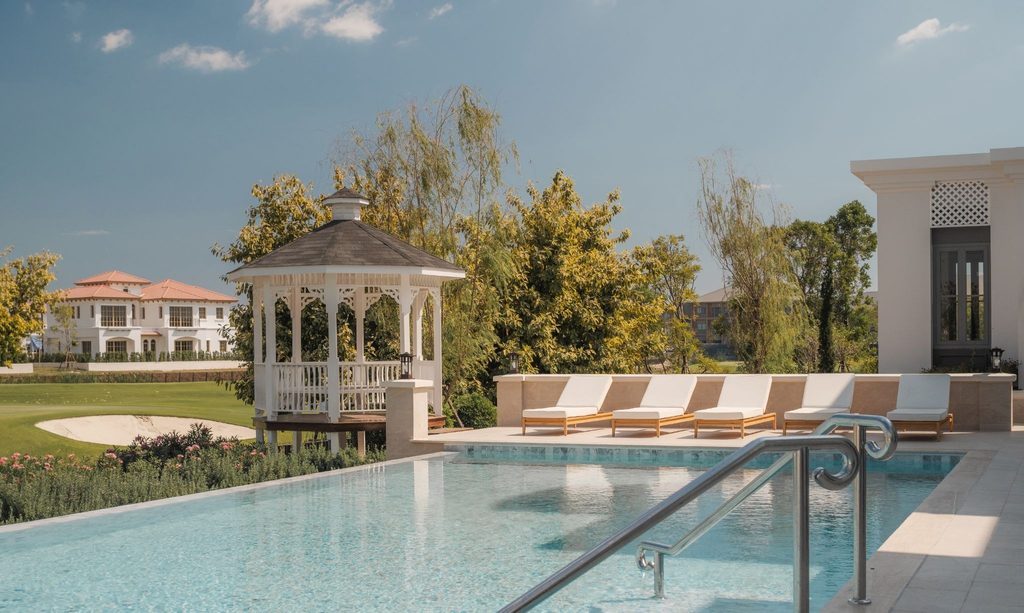
Reignwood Park, a large-scale mixed-use development in Lam Luk Ka, Pathum Thani, sits within this northern corridor, and illustrates the scale that land availability now makes possible in this part of Greater Bangkok, plots and communal facilities that would be structurally impossible to build within Sathorn or inner Sukhumvit today. It is one example among a broader pattern of developer activity moving in this direction, rather than an isolated case.
None of these four geographies is objectively the right answer for a luxury home buyer. Each represents a different trade-off between history, land, and lifestyle: Sathorn for diplomatic prestige and vertical convenience, inner Sukhumvit for lifestyle density, Nonthaburi for an established, community-scale alternative to the inner city, and the northern corridor for the scale that only remaining land availability can still provide. Understanding which trade-off actually matches a family’s priorities is a more useful starting point than any single search for “luxury home Bangkok” tends to suggest.
For more information about Reignwood Park and its residential collections in Lam Luk Ka, Pathum Thani, visit reignwoodpark.com or contact the team at [email protected] / +66 (0)2 978 8888.

